Friday, March 20, 2020

Throwback Tip #204: Make Time to Read: Recommended Reading for Business Leaders


When asked what the key to success was, Warren Buffett once pointed to a stack of books and said, "Read 500 pages like this every day. That’s how knowledge works. It builds up, like compound interest. All of you can do it, but I guarantee not many of you will do it.”

Before social distancing was a thing, we all had a million reasons not read books. Take advantage of this time to educate yourself and grow as a leader. Below is a list of recommended books to help you strengthen your business and leadership skills.

Tip: If you’re having trouble getting your hands on physical copies, OpenLibrary, Libby and Hoopla are available for accessing digital or audiobooks for free.

The Hard Thing About Hard Things: Building a Business When There Are No Easy Answers, by Ben Horowitz
While many people talk about how great it is to start a business, very few are honest about how difficult it is to run one. Ben Horowitz analyzes the problems that confront leaders every day, sharing the insights he’s gained developing, managing, selling, buying, investing in, and supervising technology companies.

Crucial Conversations, by Kerry Patterson
Learn to communicate best when it matters most. The classic guide to conversing in high-impact situations, Crucial Conversations helps you get constructive results when emotions run high and opinions vary, in the workplace and beyond.

Differentiate or Die, by Jack Trout
Bestselling author, Jack Trout, criticizes marketers for taking the easy route too often, employing high-tech razzle dazzle and sleight of hand when they should be working to discover and market their product’s uniquely valuable qualities. He examines successful differentiation from giants like Wal-Mart to smaller success stories like Connecticut’s tiny Trinity College to determine why some marketers succeed at differentiating themselves while others fail.

The Great Game of Business, by Jack Stack
The Great Game of Business is a whole different approach to running a company. With Jack Stack’s proven approach to transparency, employee education and engagement; he guarantees you will improve financial results and the lives of the people who drive those results.

StrengthsFinder 2.0, by Tom Rath
In 2001, Gallup introduced the first version of its online assessment, StrengthsFinder, to help people uncover their talents. In StrengthsFinder 2.0, Gallup unveils the new and improved version of its popular assessment, including hundreds of strategies for applying your strengths, this new book and accompanying website will change the way you look at yourself--and the world around you--forever.

The Ultimate Question, by Fred Reichheld
Loyalty expert, Fred Reichheld, shows how to turn customers into promoters who generate profits and sustainable growth. The key: one simple question—“Would you recommend us to a friend?”—that allows companies to track promoters and detractors, producing a clear measure of an organization’s performance through its customers’ eyes.

Who, by Geoff Smart and Randy Street
In this New York Times Bestseller, Geoff Smart and Randy Street provide a simple, practical, and effective solution to what The Economist calls “the single biggest problem in business today”: unsuccessful hiring.

Other recommended reading:


How you choose to spend our time now, will have a significant impact on the success of your business now and over time. Take time to consume information and education that can help you continue to build a strong and successful business moving forward.

Crave more? If you like what you read here, look for the "Subscribe now" box on the right to enter your email address and start receiving weekly tips, like this, delivered straight to your email inbox. RCI's Tip of the Week blog is just one of the many resources we offer to help candy makers refine their craft and build upon their business and marketing practices.

Monday, March 16, 2020

Tip #330: COVID-19 (Coronavirus) Guidance for Retail Confectioners

Small businesses are currently facing unprecedented operational challenges. Due to recent cancellations of major sporting events and festivals, school closures and more people working from home, there’s no doubt consumers are reluctant to leave their homes—let alone visit their favorite local businesses. Not only does COVID-19 (coronavirus) pose a threat to public health, it will have an unprecedented impact on small businesses and the economy.

What you can do now:
Keep reading as we review five steps you can take now, as business owners and operators, to protect your business, staff, customers and local communities based on recommendations by The Centers for Disease Control and Prevention (CDC) and other authoritative health and governmental agencies.
  •  Educate yourself and your team.
  •  Create a communication plan.
  •  Protect your business.
  •  Embrace new forms of commerce.
  •  Stay connected with fellow retail confectioners.

Educate yourself and your staff: Guidance for Businesses and Employers from CDC
As a leader of your business, it is crucial to obtain information about COVID-19 (coronavirus) from authoritative health and governmental agencies, such as The Centers for Disease Control and Prevention (CDC).

The CDC offers the most up-to-date information on COVID-19. Click here to view guidance from the CDC for employers to help prevent workplace exposures to COVID-19. This guidance also provides planning considerations if there are more widespread, community outbreaks.

To prevent stigma and discrimination in the workplace, the CDC recommends using only the guidance provided on its COVID-19 web page to properly determine risk. Do not make determinations of risk based on race or country of origin, and be sure to maintain confidentiality of people with confirmed COVID-19. There is much more to learn about the transmissibility, severity and other features of COVID-19 and investigations are ongoing.

Open communication with employees is key to educate and train your team on how to best prevent exposure to COVID-19 in the workplace. See below for links to additional resources addressing common questions:

Create a communication plan
According to the Small Business Administration, “it’s critical to communicate openly with your customers about the status of your operations, what protective measures you’ve implemented, and how they (as customers) will be protected when they visit your business.”

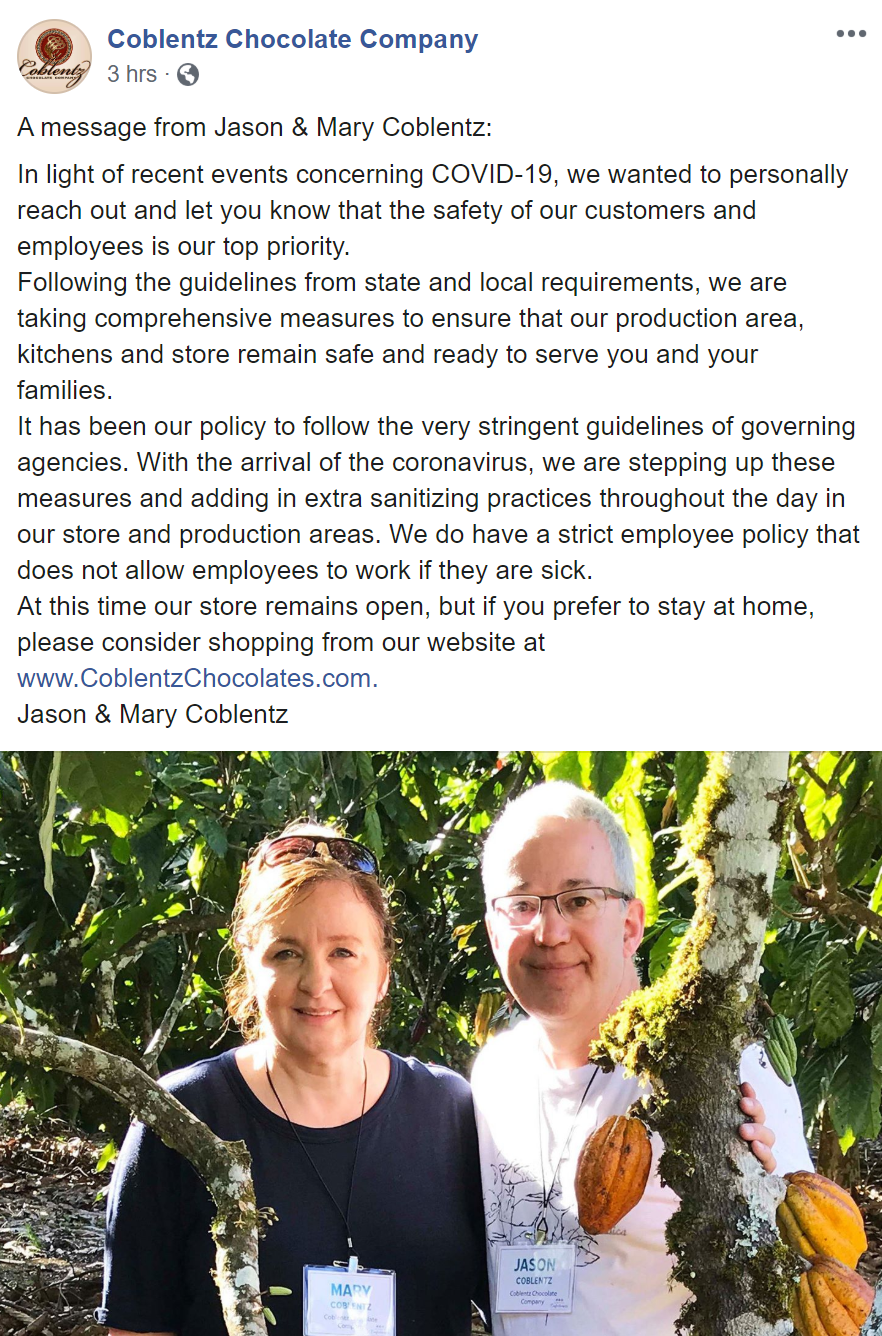
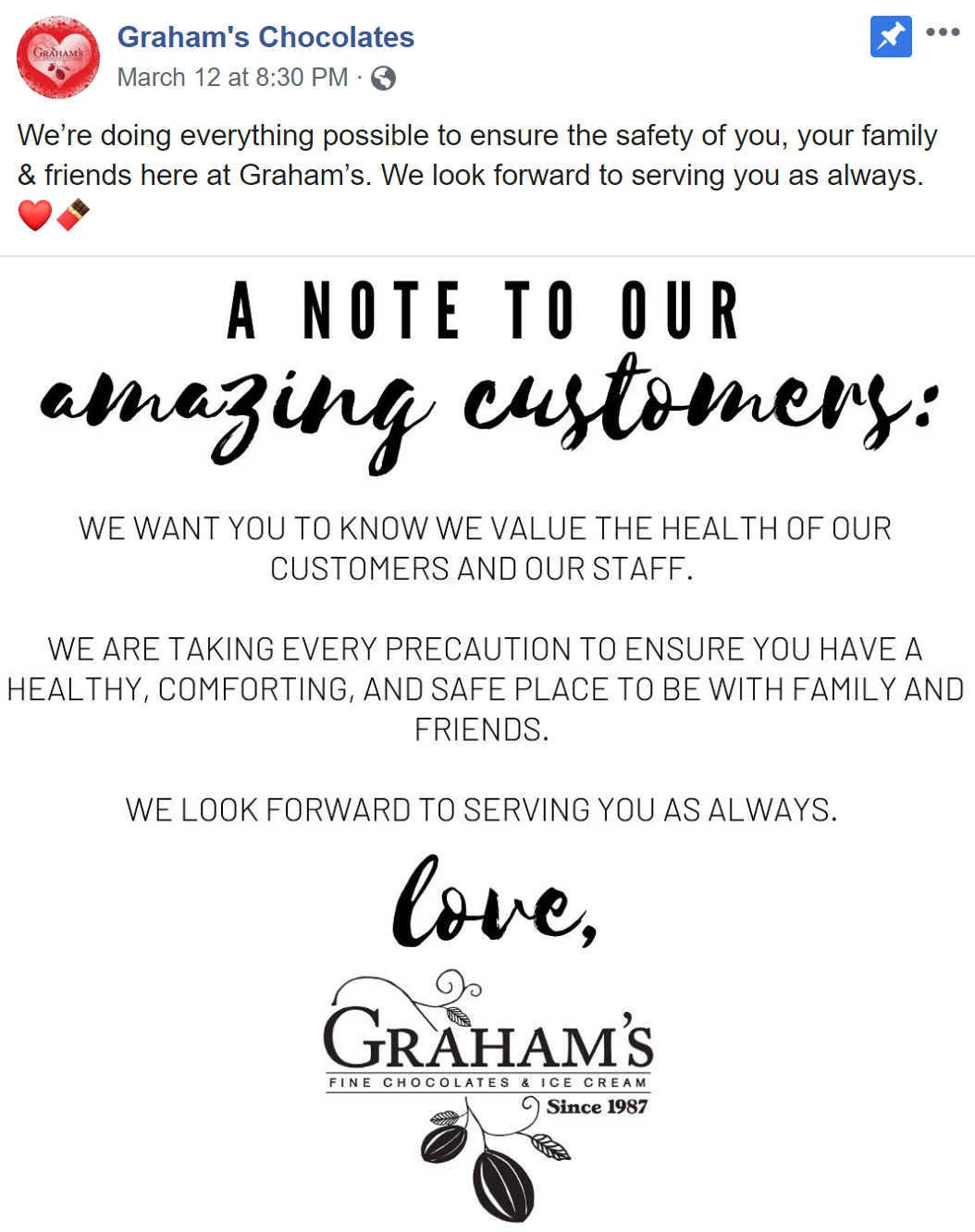
The U.S. Chamber has compiled a Coronavirus Response Kit for businesses and workers across the country, encouraging American businesses to follow data-based guidance from the CDC and state and local officials. See examples of how RCI members are communicating their new and ongoing protocols in their businesses below.


Protect your business: Guidance from SBA
The Small Business Administration (SBA) is working directly with state governors to provide targeted, low-interest loans to small businesses and non-profits that have been severely impacted by COVID-19. The SBA’s Economic Injury Disaster Loan program provides small businesses with working capital loans of up to $2 million that can provide vital economic support to small businesses to help overcome the temporary loss of revenue they are experiencing.

Find more information on the SBA’s Economic Injury Disaster Loans at: SBA.gov/Disaster. To view a full list of other local and national resources available through the Small Business Administration, visit their website.

Embrace new ways of commerce.
By providing creative and safe alternatives for consumers to continue to do business with you, may help alleviate some of the financial strain caused by current health concerns, while also helping to reduce the risk of exposure to you and your staff by consumers. Remind patrons that stocking up on a few sweet treats from their favorite, local candy shop may be just what they need to provide comfort and a constant during this time of uncertainty.

Many businesses are encouraging patrons to place orders online for home delivery and offering new grab-and-go options so customers don’t even have to leave the comforts of their vehicle. While others are encouraging consumers to support local businesses by purchasing gift cards. See below for examples of creative ways RCI members are embracing new forms of commerce to ensure business as (sort-of) usual goes on.


Stay connected.
For over 100 years, RCI has been a community for retail confectioners and their suppliers to connect with each other and learn from shared knowledge and experiences. If you have questions about what fellow retail confectioners are doing, we encourage you to subscribe RCI’s online forum, List Serve, to post questions and reply to others’ questions. We invite you to also follow RCI’s Facebook page for industry and association updates. As always, feel free to direct your questions to RCI staff at info@retailconfectioners.org

Crave more? If you like what you read here, look for the "Subscribe now" box on the right to enter your email address and start receiving weekly tips, like this, delivered straight to your email inbox. RCI's Tip of the Week blog is just one of the many resources we offer to help candy makers refine their craft and build upon their business and marketing practices.

Not a member? 
Click here to learn how RCI can help you build your sweet business.

Tuesday, March 10, 2020

Tip #329: 4 Ways to Improve Quality Control Practices


It doesn’t matter how great your confections look or taste if your business does not place an emphasis on food safety and quality control. This week’s blog post identifies four ways to ensure the safety and quality of your products with practices that you could start today.

Identify Risks
To best prevent potential hazards during the making of any food products, it is important to identify areas of potential risk. Create a Hazard Analysis of Critical Control Points (HACCP) plan to prevent biological, chemical and physical hazards during the production process that could cause a threat to food safety. RCI members, login to watch a video on how to properly identify potential risks and develop an effective HACCP plan in the past education presentation, A Practical Approach to HACCP Planning (click link to view).

Train Employees on Proper Hygiene
“Proper hand hygiene is the food [manufacturer’s] first line of defense against food contamination,” said Jim Grubb of GOJO Industries. “Bacteria, viruses, and parasites can be transmitted from person to person and from persons to food, so health and hygiene of the workforce is extremely important,” (Quality Assurance Magazine).

When identifying areas for potential risk effecting food safety, it is important to also look at current staff hygiene procedures. Since poor employee hygiene practices can lead to contamination, don’t assume staff members are washing their hands properly and at the appropriate times. Common problems with employee hygiene practices include poor hand washing practices, not washing at the right location in comparison to the production areas; manual sinks that are not kept clean; using cold water temperatures for hand washing and a poor overall food safety culture. Click here for tools and resources to train your staff on proper hand washing.

Use Both Wet and Dry-Cleaning Methods
Did you know limiting the use of water is one of the primary means of controlling pathogens in low moisture food establishments (foodprotection.org)? You are probably already using wet cleaning and sanitation methods which utilizes water and/or detergents to remove residue. When wet cleaning, it is extremely important that even the nooks and crannies of machinery is dry, because it is in these hard-to-reach places where bacteria can be difficult to remove and when water is present bacteria can grow.

The benefit to employing dry cleaning and sanitation methods, is that it allows you to remove food residue with little or no water application, significantly reducing the opportunity for bacterial growth. Dry cleaning can be as simple as surface cleaning with a vacuum or alcohol-based wipes. More detailed cleaning may be performed with a steam cleaner or dry ice cleaner.

When determining which method of cleaning is best, it is important to assess the risk level of the area in need of cleaning. Different areas of your facility may have a different level of risk, just as different ingredients would. It is important to understand what you are trying to remove when cleaning or sanitizing different work stations. According to Quality Assurance Magazine, it is essential to ensure all products used to clean and sanitize food-contact surfaces are approved by the Environment Protection Agency (EPA) in addition to being verified and validated.

Collect Retention Samples
It is important to know and understand the shelf life of your products and collecting retention samples is the best way to test product limitations, so you can adjust recipe formulations if issues arise or advise customers on the best timeframe to enjoy your products.

When testing the shelf life of your product, variables, like packaging, must remain the same. For example, when testing your products, make sure they are stored in the same packaging they would be sold in. If they are shrink wrapped before selling (which is highly recommended), shrink wrap the product before storing them for testing. Anticipate how your customers would store your products, if not consumed right away. Would they store them in the refrigerator or in the pantry? Consider a reasonable length of time a consumer may store your products before consuming them. If you are unsure, ask a small group of loyal customers or friends and family.

Over time, enlist experienced tasters (this could be staff members or, again, frequent customers) to review your products for consistency and quality. If you run into issues with product quality, RCI members can login to pose questions to fellow members on RCI’s online forum, List Serve.

This week’s tips may require extra work, however, the benefits of taking a proactive approach to quality assurance often outweigh the risks of not practicing such precautions. Comment below on practices your company employs to help ensure your products are consistently safe for consumption.

Crave more? If you like what you read here, look for the "Subscribe now" box on the right to enter your email address and start receiving weekly tips, like this, delivered straight to your email inbox. RCI's Tip of the Week blog is just one of the many resources we offer to help candy makers refine their craft and build upon their business and marketing practices.

Tuesday, March 3, 2020

Throwback Tip #296: Shipping Chocolate in the Summer is Possible! Here's How!


Are you using the correct size of gel pack?

What are you doing to prevent condensation from turning your shipping box into a soggy mess?

Shipping chocolate in the summer is tricky, but not impossible with the right supplies. With summer around the corner, we're sharing a list of must-have supplies and important considerations to ensure your precious cargo is properly packaged--thanks to the shipping experts at InsulTote by Innovative Energy, Inc.

SUMMER SHIPPING TOOLBOX
When shipping temperature-sensitive products, like chocolate, frozen gel packs are a given. Maximize the life of your gel packs by equipping yourself with the following summer shipping tools.
  • Insulated box liners
  • Large frozen gel pack(s)
  • Dry ice (for shipping frozen items)
  • Shrink wrap
  • Absorbent pads
  • Packing tape

CHOOSING your GEL PACK
When choosing gel packs, look for the largest size you can afford to ship. One large gel pack will provide better performance than several smaller ones. For example, if you place four ice cubes next to one big block of ice both at room temperature, the ice cubes will melt faster than the block of ice. The larger the mass, the longer it will take to thaw.

WITH AIR COMES HEAT
It is equally as important to fill your box as full as possible, allowing the energy from the gel pack to focus on keeping the enclosed products cold and not the surrounding air. If using an insulated box liner, press down on it to release air before sealing. For added protection, taping the outside of the box at every seam will also slow down the infiltration of air.

LINER STORAGE
Extend the life of your gel packs by storing insulated liners, in a cool place prior to use. Starting with cool air inside each bubble means the gel pack doesn't have to work overtime to cool down the air inside the liners.

SHIPPING WITH DRY ICE
To save on shipping cost, you may want to use dry ice for frozen items that will be in transit for more than 24 hours. A combination of dry ice and gel packs is the best insurance. Dry ice will keep the gel pack frozen the first day and after the dry ice evaporates, the frozen gel pack will keep the contents of the package cool for the second day. The amount of dry ice depends on the size of package, freight carrier requirements and transit times. If using dry ice, do not tape the outside seams of your boxes to allow the carbon dioxide gas to escape as it evaporates.

Using dry ice is not always recommended for foods that are not frozen, as it may give off an odor that could be absorbed by foods, such as chocolate. To keep dry ice from effecting the flavor of your product, carefully cover your product with shrink wrap and only use dry ice when necessary. To ensure product meets your quality standards, taste test it after it's been packaged with dry ice for 48 hours.

CONTROLLING CONDENSATION
The space between the inside of a corrugated box and the outside of an insulated liner may condensate in warmer weather. Occasionally this may be enough to dampen a corrugated box and cause it to become soft. To avoid this, place an absorbent pad in the bottom of the corrugated box under the insulated liner. Absorbent meat pads can be found online and are an inexpensive way to abate excess moisture.

Shipping in warm weather is definitely a challenge, but when successful, it can surprise and delight your customers and create new sales opportunities.

Crave more? If you like what you read here, look for the "Subscribe now" box on the right to enter your email address and start receiving weekly tips, like this, delivered straight to your email inbox. RCI's Tip of the Week blog is just one of the many resources we offer to help candy makers refine their craft and build upon their business and marketing practices.
Tuesday, February 25, 2020

Tip #328: Become a Better Leader: 3 Communication Principles


This week, we’re sharing tips for improving your leadership skills through effective communication techniques. Pulled from an article in RCI’s Kettle Talk magazine, Joseph Grenny identifies three key communication principles employed by influential leaders and how to apply those principles to your own skill set. Joseph Grenny is the co-founder of VitalSmarts,as well as a four-time New York Times bestselling author, speaker and leading social scientist for business performance.

I’ve spent thirty years studying what makes leaders influential. After studying more than 25,000 people, my colleagues and I found that one versatile skill set accounts for a great deal of the most effective leaders’ influence: how they deal with crucial conversations—emotionally and politically risky issues or disagreements.

Having seen how central crucial conversations are to bolstering the influence of leaders, I set out to learn how the 3 to 5 percent who master these moments do it so well. The reason I was particularly interested in these crucial conversations was because these influential leaders found a way to be honest without compromising respect, and to be respectful without compromising candor.

In my books, Crucial Conversations and Crucial Accountability, I describe key principles that result in this kind of quality dialogue and increased influence. Here are some that make the biggest difference:

#1 Learn to Look
Those who are most effective at crucial conversations are most conscious of their own behavior. They are aware of their own “Style Under Stress” and catch it quickly when their approach begins to damage dialogue. Specifically, they watch for when their own or other’s behavior moves to silence or violence— some form of withdrawal or attack. When that happens, they stop and mentally refocus on their real goals. To get back on track, they consider what results they really care about. When the other person is reacting badly, they make it safe.

#2 Make It Safe
Have you ever noticed how some conversations—even about very risky subjects—go very well? And others, perhaps even about trivial disagreements, can degenerate into combat or retreat? Why is that? We’ve found that the antidote to defensiveness in crucial conversations is to make it safe. People can listen to tough feedback so long as they feel safe with the person giving it. How do you create safety? You help others understand that you care about their interests as much as you care about your own. When they believe this is true, they open up to your views. When they don’t, they shut down. Secondly, you must help others know you respect them. Mutual purpose and mutual respect are the foundation of safety.

#3 Make It Motivating
The key to influence is empathy. Before starting a crucial conversation, influential leaders carefully think about how the problems they want to raise are affecting, or will affect, the other person. They think about the natural consequences of the situation to the other person. And they reassure others that these consequences always exist. For example, if a direct report appears incompetent, it’s likely their incompetence is as frustrating to them as it is to others. The problem is that they don’t see how their weaknesses are connected to their own concerns. However, if in a respectful way you can help them see how their own interests are served by addressing the problem, they are naturally motivated to engage in solutions.

Now let me be clear about my claim. I am not suggesting that if you Learn to Look, Make It Safe and Make It Motivating, people will naturally give you everything you want. What I am suggesting is that your influence will increase. Rather than contributing to problems by “acting out” your concerns, you’ll be talking them out—which gives you the potential for a solution.

Can these skills be learned? Absolutely. I’ve spent years developing methods for teaching and training leaders to increase their influence by improving how they deal with crucial conversations. And when they do, relationships and results improve rapidly and remarkably.

Crave more? If you like what you read here, look for the "Subscribe now" box on the right to enter your email address and start receiving weekly tips, like this, delivered straight to your email inbox. RCI's Tip of the Week blog is just one of the many resources we offer to help candy makers refine their craft and build upon their business and marketing practices.
Tuesday, February 18, 2020

Tip #327: Tempt the Senses to Increase Sales


The secret to increasing sales may be right under your nose. The best way to entice new guests and keep them coming back is to manage the guest experience through highly personalized guest service.
In this week’s post, Jeffery Smith, with Peterbrooke Chocolatier, guides us on an exploration of each of the five senses and how to use them to ensure every facet of your location makes a quality statement.

It's time to take off your day-to-day blinders and put on your guests' eyes—have an open mind and experience your retail store as one of your guests, not as the owner/operator of your business. You can do so by focusing on your individual senses and asking yourself the following questions.

Sight
As you approach your location is the front of the store clean and attractive? Is the outside paint fresh and clean? Are the awnings clean? Is the sign in good repair and does the timer operate properly with dusk? Is the glass clean on all exterior windows, and all signage in your windows professional in appearance? As you enter the location is the packaging crisp? Are the shelves well organized, uncluttered and the product clearly labeled? Can the guest easily identify the price of each item on the shelf without having to turn it over to look for the price? Are all surfaces clean in publicly visible and nonpublic spaces? Are all of your chocolate items in temper with the shining chocolate appearance?

Hearing
The sound of your location should be complimentary to what you are trying to achieve and should never be louder than a comfortable conversation level. In addition to the volume, music is just as important for setting the tone in a retail environment. If you are striving for a fun and lively atmosphere, seek upbeat tunes. Likewise, classical or jazzy sounds can create the feel of a sophisticated, high-end environment. Next, stand in the center of your location, close your eyes and listen to the sounds around you. Listen for sounds you may have become accustomed to and would normally tune out. Do you hear compressors cutting on and off? Do you hear the employees talking about last night’s date? Does the air conditioning/heating unit squeak while operating? Is the music too loud to hear anything else? You may have gotten used to these sounds, but for a new customer they could be distracting.

Smell
Does your location smell like a chocolate/candy store? Are you employing the use of a scent machine to aerate the allure of chocolate into the street as a way of enticing guests to come into your location and purchase product? Does your location smell clean and fresh in all areas, not just the retail area?

Taste
How long has it been since you sat down and tasted your chocolate/candies during operating hours? Does all of the product you sell meet your quality standards for taste? Are you sampling the freshest, highest-quality product or items that are out of date and/or old inventory? Are the creamy items creamy, the cold items cold and crisp items crisp?

Touch
Are all surfaces both inside and outside of your location clean to the touch. There is nothing worse than dirty door handles with grime under the handle. Are soft surfaces soft? Does all packaging that is touched by your guest say quality? Hopefully by looking at your location through your guests’ eyes you can make it better than it already is.

As you begin to focus more on appealing to the senses, you may be able to improve customer experiences that may have been overlooked and poorly affecting sales without your knowledge. Change your focus and see how it affects your sales.

Crave more? If you like what you read here, look for the "Subscribe now" box on the right to enter your email address and start receiving weekly tips, like this, delivered straight to your email inbox. RCI's Tip of the Week blog is just one of the many resources we offer to help candy makers refine their craft and build upon their business and marketing practices.

Tuesday, February 11, 2020

Tip #326: Show Your Customers Some Love with Inexpensive Customer Appreciation Ideas


Customers are essential to any business. Finding ways to make them feel valued is key to creating return customers and champions for your business. Below we’ve shared five easy and inexpensive customer appreciation ideas to show your customers some love today.

Choose a Customer of the Day
Use the element of surprise to delight your customers. Use your POS system or an old-school tally counter to identify your 10th customer and surprise them with one of your signature products for free or a discount on their purchase. Post a photo of the lucky winner on social media to drive in-store traffic. Let customers know they’re just as appreciated during busy holidays as they are on a random Tuesday.

Think of the kids
Being part of an industry that relies heavily on gifting holidays, consider ways to cater to shoppers with kids. By simply creating a space for kids to color and enjoy a snack, parents will be able to shop more privately for Christmas/Valentine’s Day/Easter gifts in peace. Share photos of the space on social media with details on what parents can expect and watch as grateful parents thank you with their business.

Bon Bon's Candy House created this space for kids to color and enjoy snacks
while grateful parents shopped for their Easter gifts in peace.
Send a handwritten thank you card
It may be old school, but a thoughtful handwritten note is one of the easiest and inexpensive ways to show you care. If you have access to your customers’ mailing addresses through a loyalty program or corporate accounts, consider making it a habit each week to mail a few handwritten notes to your customers. Try to make it personal or include a coupon to use on their next visit. You may be surprised how much of an impact this simple act of kindness will make.

Train your team to call customers by their first name
Calling customers by their first name makes their shopping experience personal. Train your staff to look for customers’ first names on their credit card and, then, call customers by name when thanking them for their purchase. Over time, staff are more likely to remember repeat customers and will be able to recall their names without even looking.

Say “thanks” with a video
A study by TD Banks revealed, more than 80% of customers like getting thanked in person. Since this isn’t always possible, a thank-you video from you may be the next best (and certainly memorable) option. If you request data, like customer birthdays, consider creating an email template with a video or GIF (create your own GIFs with the app, Giphy Cam) of you wishing customers a happy birthday and send it to a group of customers who all share the same birthday month. Even though it’s a template, the message will feel more personal and special with a video coming from you.

Buffer is a social media management business that used this fun GIF
to thank customers for their business.

You don't have to wait for Customer Appreciation Day on April 18 to celebrate your customers. That's why we've shared ideas easy enough to start incorporating into your business today or any day. How do you show your customers you care? Share in the comments below.

Crave more? If you like what you read here, look for the "Subscribe now" box on the right to enter your email address and start receiving weekly tips, like this, delivered straight to your email inbox. RCI's Tip of the Week blog is just one of the many resources we offer to help candy makers refine their craft and build upon their business and marketing practices.
Not a member? 
Click here to learn how RCI can help you build your sweet business.

Tuesday, February 4, 2020

Throwback Tip #312: 4 Ways Distributors Can Help Your Business


Have you ever wondered if working with a distributor would benefit your candy business? In this week’s post, RCI member Chris Romocean, with Linnea’s Candy Supplies, sheds light on a distributor’s role, as well as some of the ways a good distributor can offer value to confectioners.

HOW DISTRIBUTORS ADD VALUE
Manufacturers are not always able to service every customer as well as they would like and that’s where distributors can help. Whether due to a manufacturer's geographic location in relation to their customers or their ability to help with the administration of sales, customer service, inventory and logistics, having distributors lets a manufacturer do what it does best. Make product. To be successful, a distributor needs to add value to the products it sells.

SPEED
Manufacturer’s lead times can be difficult for confectioners to contend with, especially during holiday seasons. Lead times can be anywhere from several days to several weeks. A distributor usually has product in inventory available for immediate order fulfillment.

PRODUCT BUNDLING
A distributor should have a wide range of products that complement each other and meet the needs of confectioners. Having the ability to combine products from various manufacturers all in one shipment can significantly reduce shipping costs. Product bundling also saves time. Placing one order is much faster than placing several.

LOWER MINIMUMS
For many confectioners having a lower minimum order means they can order the quantities they need, not the quantities they have to. Requirements for precious storage space are reduced and their cash is not tied up in excess inventory.

INVENTORY
The burden of keeping a large inventory is shifted to the distributor allowing confectioners to use just-in-time strategies and smaller orders on a more frequent basis.

COMMON MISCONCEPTIONS
There is a misconception that prices from a distributor will always be higher than buying direct from the manufacturer. Many distributors have prices that are comparable and sometimes lower than buying direct from a manufacturer. Distributors purchase products in large quantities from manufacturers and get discounts based on large volume orders or quantities committed to by contract. With this discount, a distributor can offer products at competitive prices.

Another misconception is that if a customer stops buying from a manufacturer and gets their products through a distributor; they are not as important to the manufacturer and will lose contact with them. While it is true the distributor will be assuming the customer service role, the manufacturer’s technical support, expertise and knowledge will always be available either through the distributor or directly. Manufacturers value their customers and want them to be successful whether they buy direct or through a distributor.

HOW TO MAKE THE MOST OUT OF YOUR RELATIONSHIP WITH A DISTRIBUTOR
Distributors are faced with many challenges. Being able to accurately forecast, not only levels of inventory for thousands of products, but also planning for lead times and the logistics involved in replenishment is critical for a distributor’s success and the success of its customers. Good communication with the manufacturer and the confectioner is vital.

Another challenge is being efficient at getting products to customers fast, especially during the busiest parts of the year. A distributor needs to have a great team working together from the time the order is placed until it reaches the customers door.

In today’s business environment, now more than ever, a distributor creates value for manufacturers and confectioners alike.

Crave more? If you like what you read here, look for the "Subscribe now" box on the right to enter your email address and start receiving weekly tips, like this, delivered straight to your email inbox. RCI's Tip of the Week blog is just one of the many resources we offer to help candy makers refine their craft and build upon their business and marketing practices.

Tuesday, January 7, 2020

Tip #323: Assess Your Social Media Presence


Does your New Year’s resolution include improving your brand’s social media presence? If not, maybe it should. Did you know that 78% of consumers’ purchases are impacted by companies’ social media posts, according to a study conducted by customer intelligence company, Market Force.

A great first step towards improvement is to rate your social media presence as a consumer, right now.

Wait. Before you start tallying the number of followers on your Facebook page, I’m not referring to your numbers. I’m referring more to the aesthetics and the content provided on your social pages. Sure, these things are important to assess the overall performance of your social media efforts, but for now, just focus on the overall look and feel of your social media pages.

For example, how do your posts and product photos look? Are they visually appealing? Bright and colorful? Do they make you want to buy what you see? Are your followers engaged (liking or sharing your posts)? Are comments being replied to within 24-48 hours? How often are you posting? If you’re on Facebook or Instagram, you should make it a goal to post at least once a day. Do your posts always include images or videos? Did you know your posts will see more than two times more engagement if images or videos are included? Do your posts only include sales or do you offer inspiration for celebrating various holidays (from Valentine’s Day to National Potato Chip Day)? Beware: If you’re only posting when your products are on sale, you will attract followers who do not want to pay full price or are conditioned to expect reduced prices. Instead, focus on other areas of your business that make you stand out…like the fact that you make your own confections! “Behind the scenes” photos and video from the candy kitchen are as good as gold.

While assessing your social media page(s), the goal is to be as neutral as possible. If this difficult for you, ask a trusted friend, staff or family member who matches your ideal target market and will give you honest and constructive feedback. Note: If teenagers aren’t your target market, don’t ask your 16-year-old niece/neighbor/employee for feedback.

Next, focus on your company information. Imagine you’re a consumer interested in purchasing your products. What could a consumer learn about your business from your social media page? Are your physical and web addresses present? Are your store hours listed and up-to-date? How can they contact you? Is a phone number and email address listed? Next, your social media pages are, yet, another opportunity to tell your story. Make sure there is at least a short blurb about your company story, which may include when and how your business was started, what makes your products special? Do you hand-dip your chocolates or use state-of-the-art machinery? Do you like to experiment with unique flavors or use centuries-old, family recipes?

Once the questions above have been answered, assess what your business is doing well and what areas could be improved. This will help you determine your next steps. If done well, managing your social media page(s) will require an investment of time—especially if you post one day at a time. Improve efficiency by creating and scheduling social media in batches—such as a week or month at a time.

Careful consideration of the details reviewed in this week’s post will help you to improve your social media presence and create a strong brand for your business in the coming year! Let us know in the comments below if you assess your social media presence on a regular basis and what tactics you have found successful.

Crave more? If you like what you read here, look for the "Subscribe now" box on the right to enter your email address and start receiving weekly tips, like this, delivered straight to your email inbox. RCI's Tip of the Week blog is just one of the many resources we offer to help candy makers refine their craft and build upon their business and marketing practices.

Not a member? 
Click here to learn how RCI can help you build your sweet business.